Powered by Skedda: Introducing AllBooked, Skedda’s booking system designed specifically for.....

.png)
Badminton Hobart is an indoor badminton facility just minutes from Hobart’s CBD, offering 12 courts for casual play, training, and competitive matches. The venue serves a mix of social players, clubs, and regular groups, with programming that includes social sessions, junior development, and tournaments. With flexible court hire and membership options, players have reliable access to court time throughout the week, whether dropping in for a game or booking regular training sessions.
Tasmania, Australia
Athletic Facility
Badminton Hobart is a 12 court, 700 member facility hosting everything from coaching programs to major tournaments like the Australian National Badminton Championships. Five years ago, the team partnered with AllBooked to escape a frustration many growing venues know all too well: manual bookings. Spreadsheet reservations, booking back-and-forth, and collecting payments on arrival weren’t just inefficient. They were limiting growth unless the team was prepared to increase headcount.
Mark Purcell, General Manager of Badminton Hobart recalls that “it really was the manual side of taking bookings, the intensity of the admin involved, and then getting people to pay on arrival” that pushed them to look for a solution.
They were looking for relief, but what they found was leverage. Ironically, what had become unsustainable pushed them to build an operation designed to scale.
AllBooked became the foundation for that shift. What started as a booking solution evolved into the backbone of the business. As memberships were introduced, prices increased, and offerings expanded, the platform scaled with them. AllBooked absorbed their growth so the team didn’t have to absorb the admin.
With AllBooked, the team introduced:
As pickleball grew in popularity, the team saw an opportunity. The courts were there, demand was rising, and they already had a system in place to support it. Introducing the sport was less about rebuilding and more about making use of what they already had.
“As the whole world knows, pickleball is a growing sport,” Purcell says. “So for us, that meant a clear income stream we could tap into.”
But there was a risk. Badminton remained their priority offering.
“Pickleball players could be at the facility seven days a week for three hours at a time taking up all 12 courts.”
They needed a way to protect availability and manage both sports without manually policing the schedule.
“AllBooked gives us the ability to lock in the times we need for pickleball ahead of time, and then open the courts back up for badminton outside those hours.”
Mornings are dedicated to pickleball, with recurring games automatically blocked out by the system well in advance. Once those sessions wrap up, the courts automatically reopen in real time, allowing players to self-reserve badminton courts.
When asked what it would take to offer pickleball bookings without AllBooked, his answer was immediate.
“Oh, look. I’d have to employ a staff member,” he says, “We’d either limit the hours available or pay someone to sit here and manage it. And it’s counterproductive to pay somebody to manage your income sources. Why spend the money from court bookings on someone just sitting here managing them?”
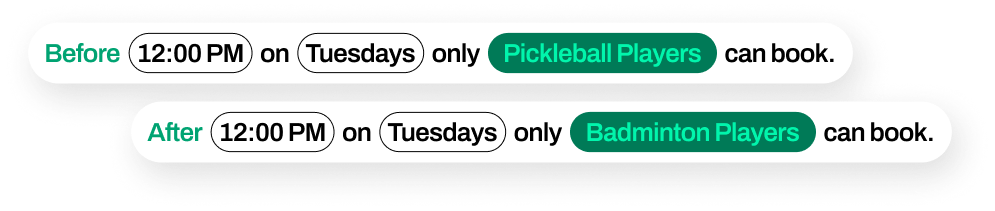
As a 700-plus member facility, Badminton Hobart supports a wide range of bookings. From memberships and walk-ins, to coaching sessions and tournaments, each comes with its own pricing structure.
“There are certain periods of time during the day, particularly the middle of the day, when we're pretty quiet, so we offer off-peak pricing,” explains Purcell. “Members and coaches pay $11 an hour up until 3:00 p.m. on weekdays. Outside of those hours, it goes to $22 an hour.”
That flexibility extends beyond pricing structure to how quickly rates can be adjusted. Annual price increases take just minutes to implement.
“When we decide to adjust our rates, we can do it very fast. If we make that decision today, we can go in and change $27.50 to $28 in under two minutes.”
The pace of their growth mirrored the pace at which they could configure AllBooked. Rates went up. Their workload didn’t.
Speed is one thing. Enforcing those rates consistently across hundreds of members and multiple booking types is another. To make that model work at scale, the team needed a way to automatically charge the right rate to the right player at the right time. The catch? It had to be completely hands-off.
Here’s how AllBooked makes it work: each user is assigned a tag in the system, and the team sets rates tied to that tag. From then on, whenever a player books, the correct rate is applied automatically.
The rest is self-serve. Customers book and pay upfront, and the venue uses AllBooked to require acknowledgement of its no-refund policy before confirmation. It’s a built-in safeguard that has, in Purcell’s words, “definitely reduced no-shows.”
“The great thing is that everything’s one touch and we can lock payments down in advance,” Purcell says.
“Ninety-nine percent of transactions are sorted out by the system. It just hits our account, and we don’t have to do anything other than reconcile it when the money comes in.”
“Taking payments up front means people have skin in the game,” he adds. “They’re going to show up.”

That same infrastructure made it possible to evolve their broader revenue strategy. Following a recent rebrand, they introduced a segmented membership tier designed for players who wanted discounted court access and insurance coverage, without the additional perks of the higher-tier option.
Before launch, they gave members a one-week grace period to adjust.
“The great thing about AllBooked is that we can easily change the prices for our memberships,” Purcell says. “It took me two or three minutes just to sit down and do it all.”
At the same time, coaches—who account for roughly 15% of total bookings, a significant share of overall court usage—continue to receive priority access through earlier booking windows. While they aren’t technically members, they receive the same discounted rate, and the system allows the team to configure both pricing and booking rules to reflect their importance to the facility.
“One of the benefits of being an accredited coach is getting that future access,” Purcell explains.
Priority bookings matter. Many coaches operate on structured schedules that require booking well in advance.
“A lot of our coaches have set days, set hours, and set courts that they want locked in for the next six months,” Purcell says. “Being able to create recurring bookings makes life a whole lot easier for both parties.”
In the end, Badminton Hobart didn’t just replace spreadsheets—they drove revenue their previous systems couldn’t support without increasing headcount. New offerings, pricing increases, and membership models became viable because the operational foundation was there.
“That’s the really clear statement for us,” Purcell says. “We don’t have to pay someone to manage it.”
“The fee we pay is more than covered by the savings on admin and the income we’re able to raise,” he adds. “The benefits of the system has more than outweighed the costs.”
The pace of their growth mirrored the pace at which they could configure AllBooked. With 24/7 access on the horizon, the next phase of growth won’t require additional staff either.