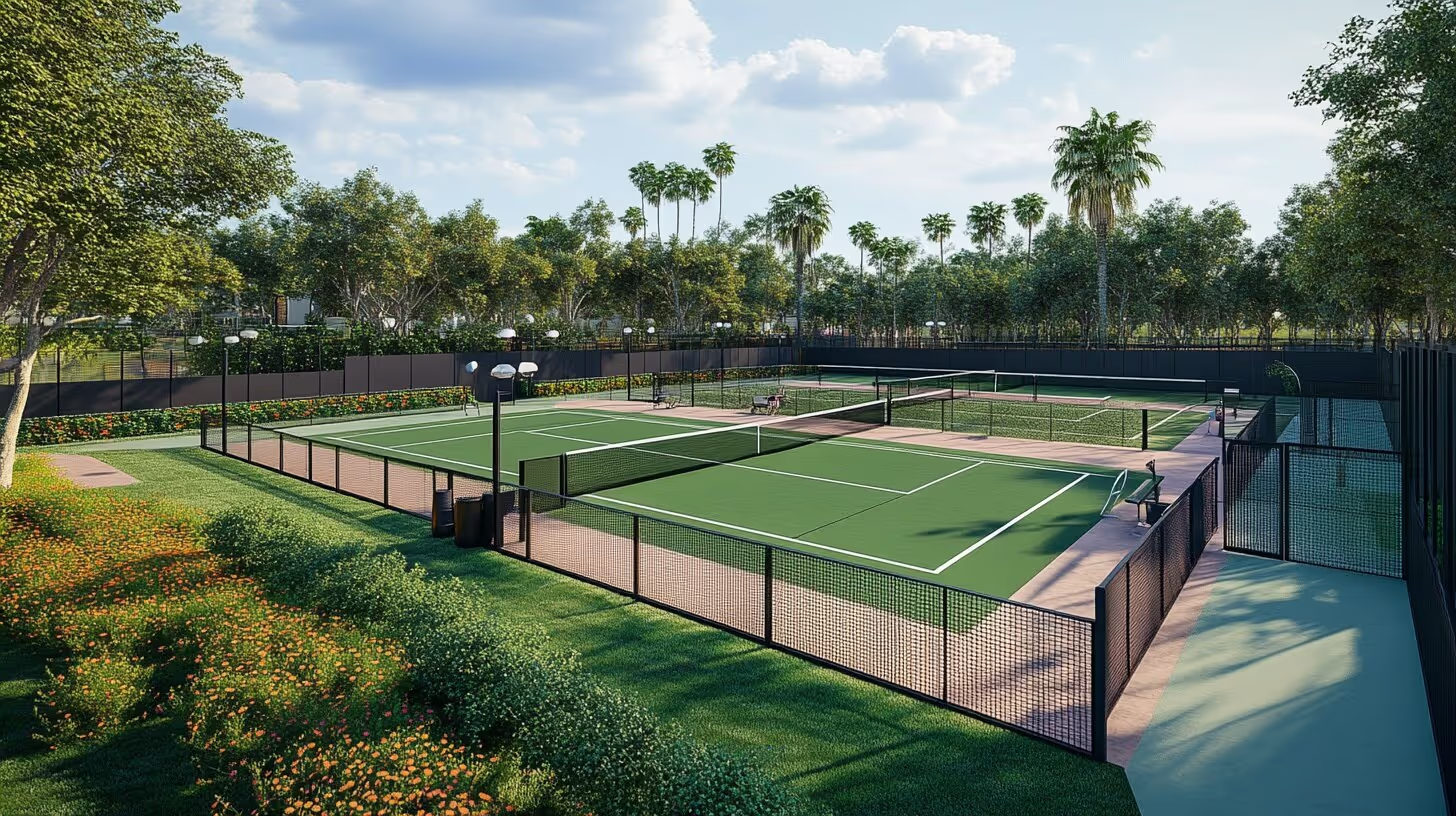
Pickleball added more than 2,300 new court locations in the US in a single year, bringing the total past 18,000. Fitness facilities just logged their 19th consecutive quarter of rising foot traffic, averaging 184,000 visits per location in 2025, up 4.2% from the year before. Golf simulator use more than doubled in five years, from 3.6 million users in 2019 to 8.1 million in 2024.
Most of the systems facilities use to manage who gets through the door were not built for that pace. A shared keypad code and a staff member with a key work fine at a fixed size. They don't scale the way bookings do.
The numbers behind the squeeze
- 18,258 pickleball court locations nationwide in 2025, up from 15,910 in 2024 — a jump of over 2,300 locations in one year (USA Pickleball).
- 19 straight quarters of growth in fitness-facility visits through Q4 2025, with the average location logging 184,000 visits for the year (Health & Fitness Association).
- Americans are projected to put $60 billion toward fitness in 2026, with the same report noting facility spend is holding up even against broader economic pressure.
- 8.1 million golf simulator users in 2024, up from 3.6 million five years earlier — a 126% increase (National Golf Foundation).
The problem: the front door doesn't scale
This type of growth demands innovation on an operational scale. There are more people to let in, longer hours to cover, and more doors to manage.
Most of the systems facilities use to manage who gets through the door were not built for that pace. A shared keypad code and a staff member with a key work fine at a fixed size. They don't scale the way bookings do.
If nothing changes, the cost shows up in two places:
- Staff time leaks into access: Every booking that needs a manual step (creating a code, confirming entry, revoking access after a cancellation) pulls someone away from the desk. This results in a cost that's sometimes unnoticeable because it’s spread across smaller interruptions.
- Demand goes unsold: Early-morning and late-night hours stay closed because nobody's there to open the door. But it’s crucial to measure the demand outside these hours to ensure the opportunity is there.
The solution: when a booking becomes a credential
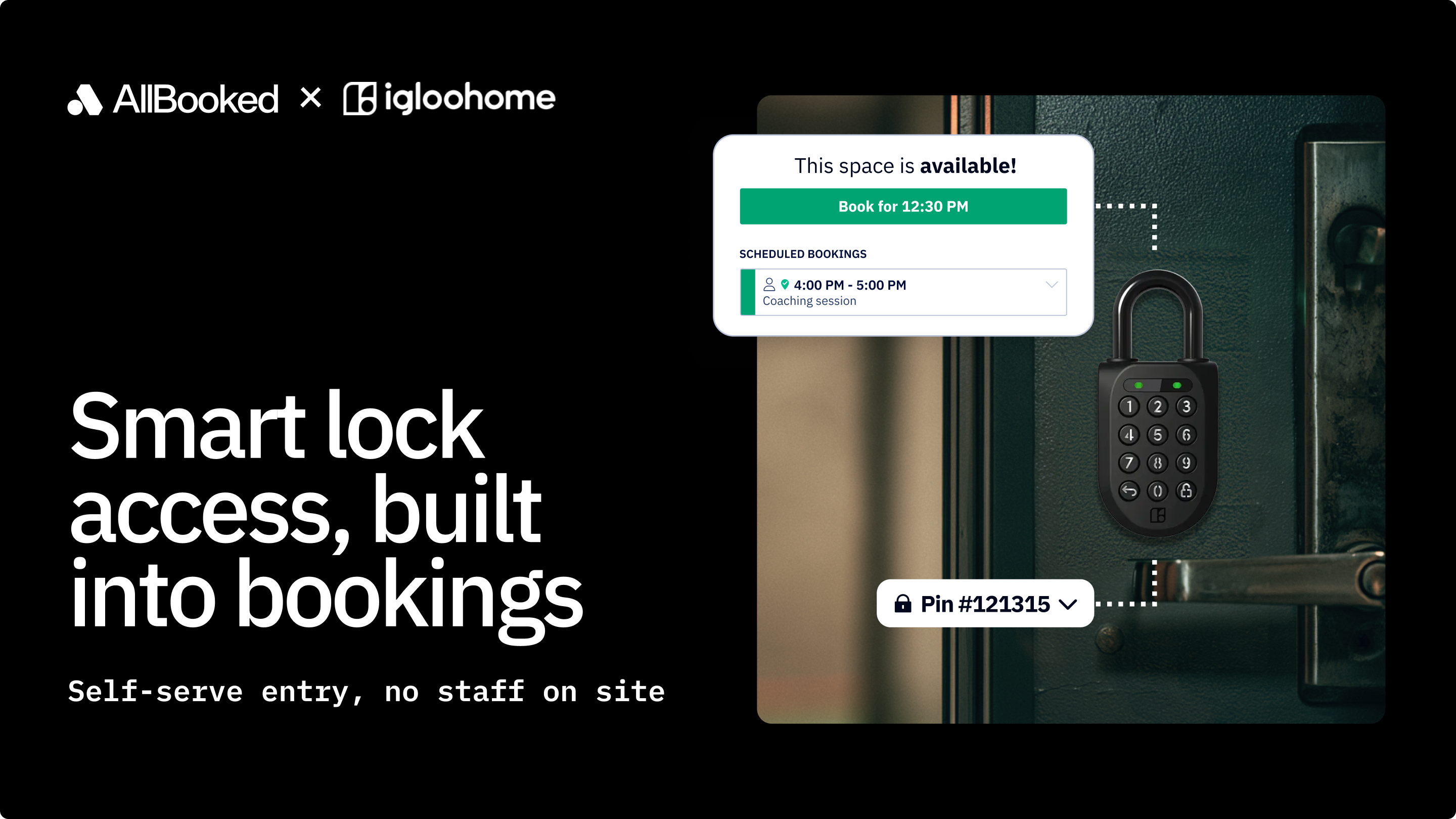
AllBooked and igloohome bring booking and physical access together, helping operators manage that growth while making it easier for customers to book a space and get inside.
AllBooked already knows who's supposed to have access and when. Connected to igloohome’s Padlock 2, the transfer of information is automatic vs. relying on manual workarounds to tie bookings to locks on your doors.
The sequence is straightforward. A booking or membership is confirmed in AllBooked. That triggers a credential, which is scoped to the right door and the right window of time. The credential reaches the Padlock 2 as a PIN or a mobile pass. When the reservation ends, gets canceled, or a membership lapses, the credential stops working without anyone having to remember to change anything.
One detail worth knowing if you're evaluating hardware for this: Padlock 2 doesn't need an active internet connection to validate a code at the moment someone's standing at the door. The lock and the app share a synchronized formula, so a PIN carries its own instructions and the padlock can check it on the spot.
So what's that worth? For one typical four-court facility, the model lands around $480 to $820 a month in staff time and new booking value. Here's how that breaks down.
The results: the integration in action
Here’s the difference when we introduce automation into the operating model.
The profile:
- Four-court multi-sport facility (basketball, volleyball, pickleball), open 70 staffed hours a week
- Two part-time staff covering the front desk and day-to-day access duties
- About 50 bookings a week currently need a manual access step, plus roughly 80 active members
- A steady trickle of requests for access before opening and after closing that nobody's acted on yet
Lever one: staff time currently going to access
Start with measuring costs of manual access coordination in staff hours.
The assumptions (replace these with your own):
- 50 bookings a week currently require some manual access step: creating a code, confirming entry, revoking access after a cancellation.
- Each booking takes roughly 4 minutes, from start to finish. Facilities juggling multiple entrances or frequent schedule changes often run higher.
The real number (for reference): the median hourly wage for recreation workers was $17.58 as of May 2025, per the Bureau of Labor Statistics (BLS).
The math:
- 50 bookings × 4 minutes = 200 minutes a week, or about 3.3 hours
- 3.3 hours × $17.58 = roughly $58 a week, or about $250 a month, in staff time spent specifically on access coordination — roughly $3,000 a year if nothing changes
For a lot of facilities, $250 a month in labor isn't what makes the decision. This provides a real floor under a cost. Run your own booking count and your own time-per-task estimate through the same formula and see where you land. A facility running 150 bookings a week through two unstaffed entrances will see a very different number than this one.
Lever two: hours you're not currently selling
This one's harder to model honestly, because it depends on demand you haven't tested yet. Check 5 Signs It's Time to Actually Automate Access at Your Sports Facility for more tips on testing whether an access automation is worth it for your business. Below is a fairly simple model to think about:
Additional bookable hours × your average booking value × expected fill rate = the upside
It's tempting to multiply new hours by your current average booking rate and call it a revenue projection, but there are some nuances to consider. A newly opened early-morning or late-night slot isn't the same as an existing peak-hours slot; it starts at close to zero utilization and builds slowly, if it builds at all. An honest starting assumption for a brand-new time slot is a lower booking rate within the first few months, not the facility-wide average. If you have signal already, like customers who've specifically asked about early or late access, that's a better input than a guess.
For this example, say 15 additional hours a week become bookable, at an assumed $35 average hourly booking value. At full capacity that's a theoretical ceiling of about $2,280 a month, which nobody should expect in year one. A more realistic starting range, assuming a 10–25% fill rate while the new hours build a following, is roughly $230 to $570 a month.
This lever can make a bigger difference than the cost of staff if the demand is actually there. It’s worth a small pilot to find out (without overcommitting): try a few hours, one entrance, a defined group, before opening it further.
What it adds up to
Combined, under these specific assumptions, this profile's model lands around $480 to $820 a month in staff time and new booking value. That's a modeled range for one plausible setup, not a promised outcome. A facility with more entrances, a higher booking volume, or stronger off-hours demand would land somewhere else entirely, which is exactly why the formula matters more than this one example does.
For more information, check out the AllBooked integrations or get started with AllBooked.