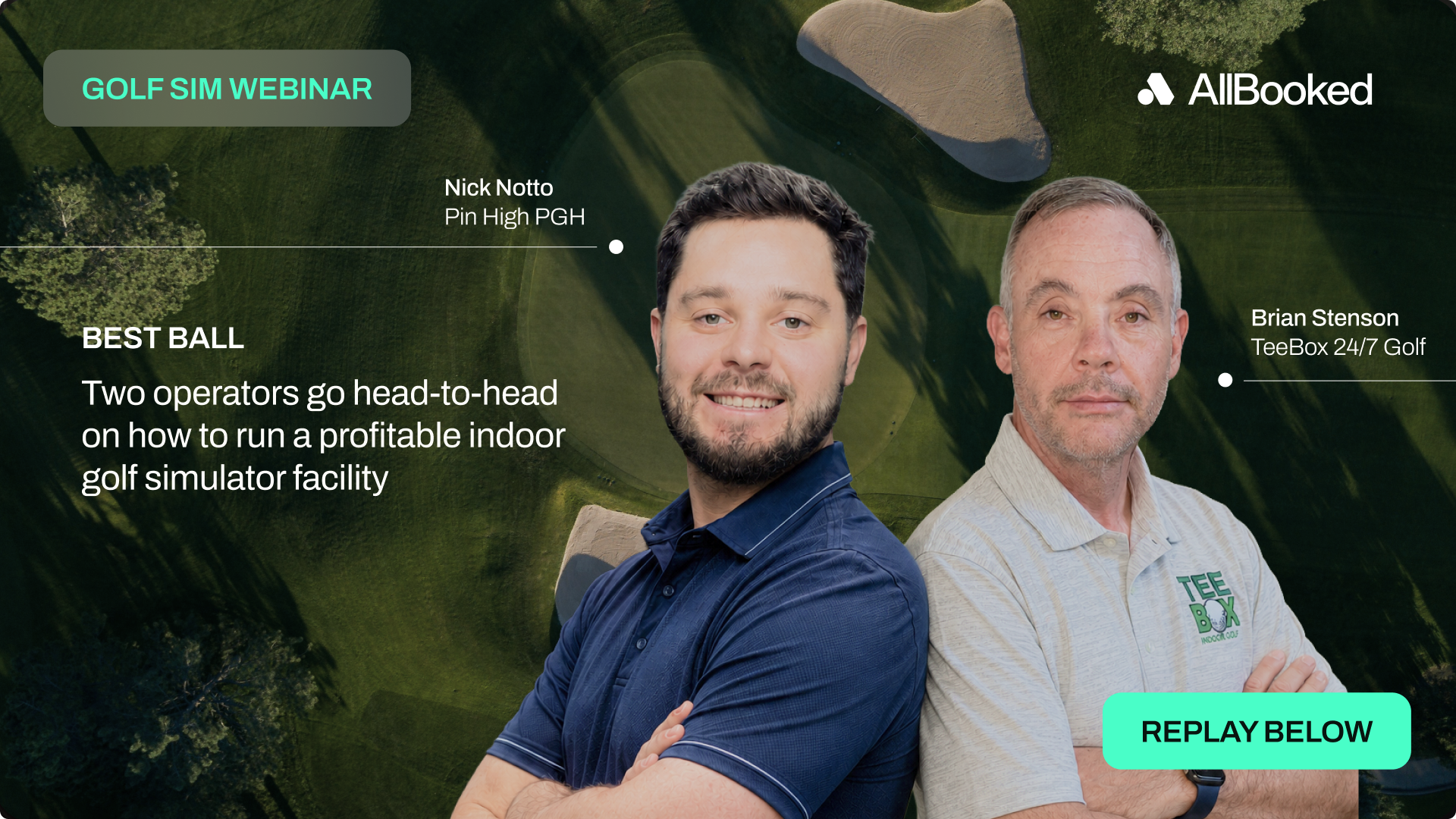
On Tuesday, August 18, AllBooked had the pleasure of hosting a webinar featuring two expert entrepreneurs in the golf sim space: Brian Stenson, owner of TeeBox 24/7 Indoor Golf, and Nick Notto, owner of Pin High PGH.
This live conversation put two operators—each with completely different golf sim business models—side by side to break down how they run their facilities, so anyone watching can take a page from their playbooks.
Stenson built a large, standalone operation with six simulator bays and an automation stack that keeps the business running smoothly while he’s off-site. Notto runs lean: two simulators, low overhead, a business he can run from anywhere, and a plan to grow one bay at a time.
Both profitable, completely different roads. Whether you're mapping out your first facility or looking to sharpen what you've already built, this conversation was made for you.

Q&A
The conversation sparked some fantastic questions, which we’ve included below. Read on to hear Brian and Nick’s answers firsthand.
Question 1:
I'm curious how you propose approaching building out a plan from scratch? I'm wondering what in that plan is necessary to work out to get to the point where it's possible to pursue (automations seem like a lot of work, building the physical space, then engaging with the community to bring people in). In short, where do you propose spending energy in your plan if starting from scratch?
Answer 1:
Brian: “I think the critical piece, at least for me, was the math. Could I make this profitable based off of what I could find out? How many golfers are in the area? How can I price this? What does my competition look like? What are my expenses gonna be? And try to do a good job of planning those out. You know, rent's obvious. Right? Like, you can figure that out pretty quickly just by going to a couple websites and figuring out what rent is. But you know, your internet costs, your utility costs. I was surprised at how much commercial electricity costs. You know I think some people I know would probably freak out if they saw my electric bill. And, you know, that's where the automation I'm using tries to control some of those costs as well.”
Question 2:
Interested to hear what Nick's and Brian's largest “surprise” costs were, when setting up the businesses.
Answer 2:
Nick: “I'd probably say to start, you don't really factor in a lot of electrician work. That was a big one for us. You do have to have outlets where you need them to be. You can't really run extension cords to one outlet. So that one was definitely a big cost. I would say also, marketing tends to be a bigger cost than you expect. I think Google does a very good job of just charging you per day, and you see a low number. And it's like, ‘oh, I'm only paying, you know, x amount of dollars per day.’ And it ends up being, well, you need to multiply that by 30 for your monthly cost. Then before you know it, it's growing pretty well there. So, startup costs probably might be a little bit higher than you think. Then, you need to limit your subscription costs too. So make sure that your security system is good, but, you know, within your budget.”
Brian: “I think my biggest dollar amount cost surprise was construction. It was insanely expensive to build out a 3,600 square foot retail space in my market. My biggest like, ‘how does it cost that much!?’ surprise was my electric bill. I have two units, so I get two electric bills. So, add those together. The other one I think was interesting was insurance. I did plenty of research, tried to find people, but finding insurance is a little challenging. My broker just recently went out and surveyed eight different companies, and only two of them were interested. So that's an interesting challenge as well.”
Question 3:
Brian, how did you automate the projectors, lights and music to turn on for bookings?
Answer 3:
Brian: “Let's see. Lights, those are IoT devices. Basically, they're embedded inside the switch plates behind the switches. They're fairly inexpensive devices, $10-15 a piece. The music is SoundCloud and they have an API. So I just tap into that and say ‘turn the volume up, turn the volume down.’ There's an iPad in the facility. People can change the music to whatever they want and control the volume. Then, because they can do that, some people shut it off. Some people crank it way up, but I limit it. I don't let them go really loud because that could bother neighbors. But I reset it back to where I think it should be. So we do that every time somebody comes in. Projectors and TVs are not automated at this point. They just go to sleep really well. And everybody knows projectors. They don't have to do anything. When the computer turns on, the projector just sort of turns on too. With the TVs, they just grab the remote and turn them on, whatever ones they want. They don't even need them if they don't want them.”
Question 4:
Nick, how did you build your connections with local schools, clubs, club fitters, etc.?
Answer 4:
Nick: “It's a great question and there's really not one universal answer for all three of those options there. So to start, our first major connection was with the college team that was very close to us. That connection came via just posting myself, introducing the business into a very large Pittsburgh golf group. That coach ended up being a member there and reached out to us before we even opened. So that was a very easy connection to make. One that I'm very glad that happened. Local schools, high schools, a lot of them do golf outings. So we get a lot of requests to donate simulator time, which is great because in return, that's what I view as free marketing. So we donate a couple hours of simulator time during our slow season when these golf outings are happening. And with that, you get a good connection base with the organizer of that event. They give a good connection with the coach and there you have a good connection with free marketing with a local golfer coming into your place. I just think it's an all around good thing. So whenever we do get requests, typically, I do donate some time. And also sometimes they do invite you to the golf outing to play, which as a golfer is a great thing as well. Club fitters. So that’s a connection we've made since my personal Instagram algorithm is all directed towards golf videos. That's probably 90% of my feed along with some football highlights. So with that, I see a lot of local golf companies pop up on my Instagram feed. A lot of the time, it's just a personalized Instagram DM. Reach out to them. They reach out back. ‘Hey. We'd love to come see the site, see what we can do with you with club fitting.’ It's mutually beneficial because it doesn't cost me anything to have them on-site. They may use a bay, but in return, they're bringing in golfers, they're bringing in traction to us, credibility, and that's been a good connection as well.”
Question 5:
Brian, with a 24/7 model, what happens at 10 p.m. at night when somebody can't get in, and the simulator freezes or something gets damaged?
Answer 5:
Brian: “So my members are the only ones that can get in after 9 p.m. And so, what I've done is, I've set this up so that nonmembers have access to the facility between 9 a.m. and 9 p.m. during the week and 10 p.m. on the weekends when I'm awake. Right? And so I can log in. I can see what's going on and that usually isn't a problem. My members, they're in regularly. They've maybe experienced some things. They have some idea of how to control stuff. They all have my phone number. They text or call me and, fingers crossed, I haven't had any issues. But, you know, that's a possibility. My phone isn't on vibrate anymore. Right? We've done a pretty good job of making sure things work. I have done a number of things over my automation to try and enhance it. So, you know, before it was like, ‘okay. Turn it on. Right? And turn it off.’ And maybe something didn't go right, and I didn't know that right away. So I was busy. I couldn't check on it. So I've built in some automation around checking to make sure that everything is the way it's supposed to be. Right? And then if that's not the case, I get a big alert. Like, it's some big blaring alert on my phone that tells me, like, ‘hey. Something is wrong,’ so that I can react. That usually would come in before anyone would even call me. They also have videos they can watch. They have websites they can go to. There's a QR code in the bay. They can scan that, and it takes them through some steps. You know? But realistically, worst comes to worst, just shut the computer off, turn it back on. And they all know that. Like, my members know that.
It's like the same thing any IT guy would tell you. And it's basically set up so that when it turns on the first time, it does everything it's supposed to do. You just sit there and wait and watch, and thirty seconds later, you can go golf again.”
Question 6:
Keen to hear about 'seasonality' peaks and troughs, or even weekly/daily patterns that have emerged and surprised you.
Answer 6:
Winter is where the money is in a cold-weather market. Brian expects most of his revenue to come from that season, and he opened in February with it already underway. He's been open about what he learned from that. “I know that I missed out on some customers because they were already going somewhere else.”
He's now pushing to get golfers signed up before the season starts. He also points to the cyclical nature of the business as the reason to keep a tight pricing model that supports consistent demand.
Summer is Nick's slow season. He uses those months for local golf outings, donating simulator time in exchange for exposure instead of trying to secure bookings that might not be there. On daily patterns, Nick's peak runs 5 p.m. to 9 p.m. When demand began outpacing his capacity, he added another.
“I was looking at the times that people actually wanted to play. Once those peak windows were consistently constrained, I knew the problem wasn't marketing anymore. It was our capacity.”
Brian's surprise came from a request from a friend who asked about a summer plan for his son in college. Brian built one, and those members ended up filling his overnight hours. “They used all the hours that everyone else wasn't using. Most of my members are family people, they're in bed by nine. These guys were in at one, two in the morning.”
Both of them use memberships to shape demand. Brian's entry-level White Tee tier is weekday-only, and overnight access is limited to members. Nick built his practice membership around the specific hours he needed to fill.
Question 7:
Nick, what type of investments did you make back into the company early on? Obviously you already had quality launch monitors.
Answer 7:
Nick was intentional about the numbers early on. Every expense had to improve the customer experience or take work off his plate. “Every dollar early on went towards better technology instead of some unnecessary expenses. I really focused on those purchases that came with good customer usage and in return a good return on investment.”
He launched his second bay in March, a few months after opening, once his utilization justified it. That's what also opened up his business for larger events.
He also put money into automation and remote access, which replaced a fully manual open. “When we first opened, I was actually driving to the facility for every booking. I was opening up the door for every customer. I was manually turning on the sims with remotes.” Entry and sim power-up are hands-off now, and he runs security from his phone.
Question 8:
If you have a booking company and website, but you choose to switch to AllBooked, how do you do that seamlessly without interrupting booking?
Answer 8:
This one's on AllBooked rather than our panelists. AllBooked is the first and only booking platform either Brian or Nick has used, so neither has a migration to speak to. What Brian can speak to is evaluation. Before opening, he researched the 80-plus golf sim platforms on the market before narrowing it down to 29. Very few passed his 24/7 automation test.
On to the question. Your customers don't have to feel a major switch at all, even on the day you set everything live. With 4,000+ venues using AllBooked by Skedda, our onboarding team knows how to make the switch smooth and support you every step of the way. The team helps you set everything up fully: spaces, pricing, tiers, booking rules, and payment processing all get configured while your current platform keeps taking reservations.
From there, you and the onboarding team pick a cutover date and stop forward-booking in the old system. Direct new reservations into AllBooked, and, right within AllBooked, block off the specific windows where your old system already has bookings. The old platform stays up only to serve what's already on its calendar.
Moving your member records is part of onboarding, and it's completed before you make the switch official. We recommend emailing your members about a week out so they know booking is moving and their standing times are coming with them. In this email, be sure to include the link to your new AllBooked portal.
Question 9:
Do you give discounted rates for local pros who want to conduct lessons onsite? How did you decide how to structure that part?
Answer 9:
Brian does host outside pros. Three of them teach out of his facility, a group of two plus one more. “These guys have bays assigned to them. So when you either book a lesson with them, or they go ahead and make a booking for lessons, it blocks that bay off.”
So a golfer books the bay with a pro, and that bay drops off the public calendar automatically. Brian set this up once using space sharing rules and hasn't had to manage it since. No double bookings, and no coordinating over text.
His pros pay a discounted rate for the bay, which is about 40% off the regular weekday rate. Nick's outside professionals are club fitters, and he doesn't charge them at all.
“It's mutually beneficial because it doesn't cost me anything to have them on-site. They may use a bay, but in return they're bringing in golfers, they're bringing traction to us, credibility.”
Question 10:
How do I know my area will support the business?
Answer 10:
Brian started with the math. “Could I make this profitable based off of what I could find out? How many golfers are in the area? How can I price this? What does my competition look like? What are my expenses gonna be?”
He also chose the category deliberately. A visit to the PGA conference is what sold him on the size of the audience. “Golf is a huge market, much bigger than if I was considering baseball or softball. It's kids, it's old people, it's everyone.”
From there he worked backwards from rent to capacity, which he described in hotel terms.
“I can't make more widgets. Whatever size space I get, that's the amount of widgets I have. How many bays am I gonna need to cover my rent and make the profit that I need?” For his market the answer was six bays.
Then get specific about your trade area, because it's likely smaller than you'd assume. “I'm not advertising to a national market. I'm advertising to the three miles around me. My customers don't live very far from me. They're all in the same ZIP code.”
Nick took a different approach to the same problem. Rather than forecasting, he opened with one bay and let the data drive his next decision. “Having one bay by itself lets me learn the business and my customer needs without taking any additional financial risk upfront.” His rule for scaling after that: “Don't expand on a tight budget because you're excited. Expand because your numbers consistently tell you it's time.”
Connect with Brian + Nick on social media:
Instagram: @teebox247golf
LinkedIn: Brian Stenson
Instagram: @pinhighpghgolf
LinkedIn: Nick Notto
AllBooked by Skedda is a booking platform that specializes in the golf simulator industry. If you’re interested in learning about how AllBooked can help your facility, schedule a call with us here.
Transcript:
Jillian McGuire:
So welcome, everybody. Thank you all for taking the time to join us today. My name is Jillian McGuire, and I work at AllBooked by Skedda, a booking software that specializes in golf sims. I will be moderating today's discussion between two expert entrepreneurs in the Golf Sim space. Before we get going, just a few housekeeping things. I wanted to note that this conversation is being recorded, so you'll get everything right to your inbox afterwards. Now, onto the fun stuff. On the call, we have Brian Stenson, owner of Tee Box twenty-four-seven Golf in Downers Grove, Illinois. He's built his six bay facility to run completely hands off and deliberately skipped food and beverage. So this is all to keep overhead low and attract the clientele that he wants. We also have Nick Notto, owner of Pin High PGH in Moon, Pennsylvania. He started his business as a passion project and has grown it one bay at a time with low overhead. So at the same time, he's built out things like events and birthday parties and corporate outings, all of that fun stuff. So we have two very different setups. But underneath it, they're both chasing something most people in this space want. A profitable business that doesn't need them working at all hours of the day. So Brian and Nick have gotten there in almost opposite ways, and that's exactly what we're gonna dig into today. So let's take them to the stage, introduce themselves, and get started. So without further ado, welcome Brian and Nick. Hello. How are we doing?
Brian Stenson:
Great. Thanks. Great.
Jillian McGuire:
Well, welcome. I'm gonna kick it off with Brian. So, Brian, why don't you go ahead and introduce yourself? Tell us about your business, a bit about what you're looking forward to sharing today, all that fun stuff.
Brian Stenson:
Sure. So this may surprise some of you, but I'm not a golfer. Sports is my blood. I played sports my whole life and I've coached youth sports for over a decade. My adult life is really centered around business operations, sales, technology and that is what drove me to build this business. It's an automated six bay, twenty-four-seven, unstaffed golf simulator store. I service my community. My high schools come by and they use it for training. All the good golfers in the area, hopefully, all of them use it to get better. I have pros that work there. We hold events and things like that as well. And, hopefully by the end of this you'll know that sort of an automated business is not just possible, it's profitable. It really helps control, as you said, the cost of running this.
Jillian McGuire:
Fantastic. Oh, I'm excited to hear from you, Brian. Nick, I'm gonna hand it over to you now. Go ahead and tell everybody a bit about your business, what you're excited to chat about today, all that fun stuff.
Nick Notto:
Yeah. Absolutely. But hi, everyone. I am Nick Notto. I own Pin High Pittsburgh, and that's in Moon Township. In case you guys have no idea where Moon Township is, it's actually right near the Pittsburgh Airport. But a little bit about me, I actually work full time as a pharmacist. So Pin High Pittsburgh started as a side passion project for me that quickly turned into a business. At the beginning, I just opened up with one simulator bay and with the focus of keeping overhead low before expanding out. Today, we have two Foresight Falcon Bays. We host everything from individual practice sessions to leagues to birthday parties, corporate outings, and we just started doing club fitting events as well. One thing that's been really important to me is building relationships with the local golf community and creating that very distinct Pittsburgh feel. I'm excited to talk about starting small, growing deliberately, and enjoying the process all along with building a golf business.
Jillian McGuire:
Sweet. Thank you so much, Nick. Before we get into it, if you got questions for Brian and Nick as we go, drop them in the Q&A box. We're gonna open things up to your questions later on so the earlier you get them in, the better shot we have at getting to yours. So with that, we're gonna get into it. Brian, let's start with you. Your facility runs twenty-four-seven fully unstaffed. Later on, we'll get into exactly how that works under the hood. But for now, go ahead and give us the big picture. What actually happens when somebody books a bay?
Brian Stenson:
Sure. And when we say unstaffed, there's still people that clean. That's me. And keep it nice and tidy. That I haven't automated that. I don't know if anyone would give me the Jetsons robot, figure that out. That'd be great. The Roombas aren't good enough to really do turf well, so I've skipped that. But reality is users when they book from my perspective, I don't want them to know they're interacting with the whole technology stack of three or four or five different pieces of software and code behind the scenes. They should make a booking. They should receive an email or a text message with the information they need to be successful and they should be able to open the door and play. And that's really what we shot for when we put this together. And, really, they go into AllBooked and they click an open time slot. And within a few seconds of paying they've got everything they need. They have an email that has their PIN code in it. The facility will be set to turn on and run for them. All the lights will come on. The computer turns on. The projector turns on and the music turns up. And when their session's over, they're receiving a notification on the screen that says, hey. You're gonna be done in about ten minutes or so. Click this QR code. Scan this QR code if you wanna book some more time. If not, some time after their session is supposed to be over, it just shuts off and the lights turn off and they kind of if they're still there, they get a little ushered out just because they can't do anything. But generally most people when they see that QR code, they scan it and try and add more time to their sessions. So that's great.
Jillian McGuire:
That's very cool. And it's gonna be so exciting to walk everybody through that a little bit later on, but thank you so much for the high level, Brian. Nick, your model looks pretty different. So you've built things out like events, birthday parties, alongside day to day bookings with two bays. So walk us through how your business works.
Nick Notto:
Yeah. So we intentionally stayed small. We invested heavily into the customer experience, very similar to how Brian did with the limited space. We had to start. Every dollar early on went towards better technology instead of some unnecessary expenses. At the beginning, I was very particular about what I was spending that upfront money on, and I really focused on those purchases that came with good customer usage and in return a good return on investment as well. We chose Foresight Launch Monitors mainly because accuracy was very important to me. I wanted to really focus on the golf aspect a lot more than things like a food or a bar because those kind of things can create an overhead especially with labor needs as well. We focus heavily on the local Pittsburgh golfers. There's multiple demographics there and those who actually want to improve all while having fun playing the sport. At the same time we've built a place like Jillian said families, birthday parties, businesses can enjoy. The space is actually like an open room, so it can be very easily configured to fit large groups for events. We've made it very easy for organizers of those events to schedule those events especially throughout our website as well. Being in Moon Township, it lets us serve the neighboring communities. If you guys are familiar, Robinson, Coraopolis, Sewickley, the airport area, and then we also stretch all the way down to Downtown Pittsburgh. We've collaborated with some local organizations already, including Robert Morris University. It's only a mile away from us. They've been great in our development, and we're going to continue to look for any sort of community partnerships through charitable donations and golf outings to get our word out. A big mission of mine right now is I wanted customers to feel like they're supporting a local Pittsburgh business instead of walking into a national chain that may have been created on the other side of the country.
Jillian McGuire:
Cool. Thank you so much, Nick. So both of you have built something completely unique. Brian, the systems that let you run twenty-four-seven, and Nick, a model built by design to grow deliberately rather than chasing scale right away. So I'm curious to hear how much time running your business takes. So Nick, talk to me about how much time you spend managing Pin High, how much of your week goes towards running the business and which tasks tend to be least and most time consuming?
Nick Notto:
Yep. So when we started, it was certainly a lot more of a manual process than my operations are now. I currently spend maybe two to three hours a week at the facility, and that kinda depends on the demand schedule. But I know Brian briefly alluded to this before, but a lot of those hours are the boring work. It includes the cleaning, restocking, and bay maintenance. Those are gonna be probably the most time consuming. But on the flip side, being on-site also allows me to innovate while I'm there and kinda see firsthand how things can be arranged or configured to improve, especially since we are a pretty new business. I do spend some time on manual daily operating tasks as well. These include sending out our access codes, updating league standings, and also our on-site screen display. Extra time weekly, I spend on what I consider the fun stuff. I like to create my own Instagram and Facebook ads as well as some calls pop up during the week with local organizations. I will admit, I do spend some time using my own product as a golfer if there is a bay open, but I guess that's just a perk of being the owner of the business.
Jillian McGuire:
That's awesome. I love it. Brian, I'll turn it over to you. I know you've automated your entire workflow from start to finish. So how much time do you spend each week on a business?
Brian Stenson:
Yeah. And like Nick most of my customers ask me you golf here all the time. And I say no. But I do swing the club every once in a while. It does it's nice to do some activities. But, realistically, I'm at the store maybe one to two hours a week. I can get my cleaning organized and make it look new in about twenty, twenty five minutes. I've gotten pretty good at that, and I'm starting to farm that out to my kids. They were asking for jobs, so I've given they can drive, so I've given that to them when they're available. But I what I try to do is I coincide my trips to the store with either new customers or some customer that I'm trying to get into a membership or something like that. Being automated in twenty-four-seven, I don't have the opportunity to build a rapport with them. So other than the software they engage with, the website, the facility. So if I can take those opportunities, I'm gonna take them. And I try and do that as much as possible. Most of my effort is spent away from location. It's spent on things like accounting and IT, and I'll throw marketing in there as well. I think that's the bane of my existence sometimes unfortunately. Maybe, Jillian, you can give me some pointers. But realistically the accounting and IT pieces and the marketing take up a little bit of time. Otherwise, it's almost part time. I'm noticing when people check-in. I'm checking on the cameras when there's somebody that shows up and just trying to make sure that everything looks good. Is stuff going along the way it should be? So when someone starts, I just pop open my phone, and I just look at it. Like somebody might be looking at a text message. I'm usually popping up my cameras and looking at that. So I don't know if I could add that all up, but it's not a lot of time. And then new customers get a little orientation when they first come by. Automated messaging to them, but what I've learned is as many times as I may email or text someone, they don't read it or they tend not to read it. So I do my best to try and just give them a quick call. As soon as I know it's the door open, when someone's supposed to be there, I give them a call. Sometimes they just leave a voice mail, and most people are really appreciative. If they don't answer because they're playing, they send me back a text message. Oh, thanks for calling things like that. So it's I feel like most people there know me even though they don't know me. That makes sense.
Jillian McGuire:
Awesome. And welcome back. Thank you. Thank you. My Wi Fi went out, so now we are on a hot spot. And that's how it goes.
Brian Stenson:
You volunteered to help us both with marketing.
Jillian McGuire:
That's awesome. Oh, I would love to. Cool. So let's talk about the bigger picture now. Memberships. And I know that you both have strong opinions on this one. So, Brian, I think you have more than a three tier membership system including a 50 person tier. So go ahead and walk us through that.
Brian Stenson:
Yeah. So my background was SaaS software. And so I love recurring revenue. Those metrics are just ingrained in my head. And so what I tried to do is create a program that would allow people to expose themselves and experiment with Tee Box and then ultimately become really invested in it. So I have three membership tiers, a white tier. It's a $100. It gets you Monday through Friday, four hours a month. It's really easy. I've had people buy it, go once, and then say can I upgrade? And that's really the plan for it. I also have plenty of people who use that just because they just don't have the time to really golf. They like golfing, but their life is so busy, they can only squeeze out a couple hours a month, and they do it because they get a great deal. They can't golf for that $100 for four hours a month. It's you just can't do it. So they take advantage of that. My mid tier is really the sort of the everyday golfer. Somebody who wants to be the best golfer in their group. So they'll come in with their buddies on a weekend and they'll but they'll have golfed two or three times already that month at the simulator. So they're the best one on the team. And then I have another tier. It's my founder tier. That's my limited tier. That's basically unlimited golf. It's four hours a day. They can use the facility. They can book two bays, three bays. It doesn't matter. And they can come in and do that. And all members have the ability to keep buying hours as well. So it's great. If they wanna book their four hours as a white tier member, they can then book a couple more after that if they wanna keep golfing. So and they get a discount for that. My goal is to have everyone be a member. Basically, I'm giving them a great deal, and they're giving me some sort of stability back, some pricing stability. And I even encourage people to try and buy the annual membership as well, which gives them an even bigger discount. But so that we can have that revenue continuing to come through the door.
Jillian McGuire:
Yeah. And I assume obviously with recurring revenue it also it builds loyalty and people feel more part of a community and that type of thing. So totally hear you on that. Yeah. Nick. So you deliberately did not do memberships in year one. Can you talk to me about the thinking there?
Nick Notto:
Yeah. So I purposely waited probably about two or three months past our opening. We opened in January, so that's gonna be right in the middle of all the Northeast indoor golf facilities busy season. The reason for that is early on, I just needed data, and I didn't have the availability, especially opening with only one bay, because members typically book the popular times. And if the popular times are consistently booked by the same person that prevents potential customers from coming in. So I kinda wanted to understand who my customers actually were before locking myself into a membership model. And my first focus was as any new business, getting people through the door. And once I understood the demand patterns, we did open up a second bay. I was able to introduce a practice membership just one tier, but that was designed around my business and the hours I need to fill specifically. It also let me avoid any overselling of memberships that could potentially hurt availability with our limited bays. So looking back, waiting gave me a lot more confidence in how to structure it. Like Brian said, consistent recurring revenue is important, but also wanted to promote open availability, and I'll be looking to expand on our membership packages during our next busy season.
Jillian McGuire:
I think that is also really, really interesting that you've started by looking at the data before you made any decisions, which is an extremely good takeaway as well. So considering memberships when to add a tier, when to add capacity that actually leads right into the next one. So can we talk a little bit more about when you know it's time to grow? Nick, so you went from one bay to two in about three months. Is that correct?
Nick Notto:
Yes.
Jillian McGuire:
So what made you decide to expand, and what would you recommend to somebody who's considering scaling?
Nick Notto:
Yeah. Absolutely. Great question. But I didn't expand because I wanted to. I expanded just because the demand justified it, and I was able to look at our utilization percentages during our peak times. And, again, shout out to AllBooked because they gave you a great dashboard that lets you get all of your insights. So this gave me the knowledge to move forward with this decision. I wasn't just looking at overall utilization as well. I was looking at the times that people actually wanted to play. Once those peak windows — and for us it was between five and 9PM — once they were consistently constrained, I knew the problem wasn't marketing anymore. It was our capacity. So having one bay by itself let me learn the business and my customer needs without taking any additional financial risk upfront. Once bookings showed consistent demand and I understood operations of the one bay, adding the second bay became a much easier decision for me. The second bay increased flexibility for leagues, fittings the membership packages we talked about, larger groups especially, and it all started almost immediately after we opened up our second bay in March. My advice here, I guess is don't expand on a tight budget because you're excited. Expand because your numbers consistently tell you it's time, and making sure also that you have your operations at a level under control before doubling it in my case.
Jillian McGuire:
Yeah. That makes a whole lot of sense. I'm excited to see when and if you add another bay in the future and all of that. Brian, so you started with six bays at launch. And I know you have a thought process behind that, so I'm gonna have you share your perspective from a business from your business perspective.
Brian Stenson:
Yeah. So I'm in the Chicago land area, so rent is expensive. And I did the math, and I said, I've got a hotel model. Basically, I can't make more widgets. Like, Nick, you made one more widget. I can't make any more widgets. Whatever size space I get, that's the amount of widgets I have. I just need to book as many of those as possible. How many bays am I gonna need to make cover my rent and make the profit that I need? And six was there. I thought going bigger than that would have been great, but at the same time, I'm exponentially increasing my costs. HVAC, rent, etcetera were just getting a lot more expensive the bigger I went. And the build-out costs were gonna get very expensive as well. So six was sort of that sweet spot. And realistically, it was it took me a long time to find a space that could fit that and make it work. So for me, my expansion has really come out of things like more membership plans. So I talked about the three that I have, but I added two other ones. I have a student membership. I've got some really elite kid golfers in the area, and they were looking for a place to golf. And they said, hey. Can we do a student plan? And so I've got a student plan for them. It's high school students only. It's a couple $100 a month, and it's their practice. They come in. I give them plenty of time to come in and practice. And I then had an I had a friend call. So my son loves golf. He's home from college. Can I get him in for the summer? And I'm like, sure. What does he wanna do? So we worked out. What does the student home for the summer plan look like? And so I created that. And that was great. I got a bunch of college kids come in, and they, of course, used all the hours that everyone else wasn't using. So most of my members are family people. They're in bed by nine. These guys were in at one, 02:00 in the morning. They're basically my late hour group. And they've all loved it. They come up with their friends, they golf. I can always tell they're wearing flip flops or slides or whatever. And then I've also brought in my high school teams. So they're starting to golf. I've got half the high school teams in the area golfing with me. In fact, another one came in the other day, so that's been great. I also give them a great discount. Like I said, youth sports is big for me. So I just work with them and said, hey. What do you guys pay at the driving range? Just come on over here and you pay that. So they get really steep discounts. But it's a whole bunch of people in my facility. The other day, I had almost 30 kids in there playing golf, and all their parents came by. And half of them were like, oh my gosh. I didn't know this place is here. So it's been great word-of-mouth. It's been fantastic. And I'm looking at doing fittings and things like that as well besides my lessons and all that other stuff that we do.
Jillian McGuire:
So you got a lot going on, which is fantastic, and you're kind of responding to, obviously, your market. So that's fantastic.
Brian Stenson:
Mhmm.
Jillian McGuire:
And I'm sure that's helped you scale. But I know that automation has also played a huge piece in that.
Brian Stenson:
Yep.
Jillian McGuire:
So I really just kinda wanna take this time for you to walk us through what's running behind the scenes the tech stack, the integrations from the moment somebody books until they are in the bay start to finish.
Brian Stenson:
Yeah. So I couldn't do all the things I'm doing and live my life. I have two high school kids, twins. They're in sports. I'm traveling all over the country for that stuff. And so I definitely needed an automated place. I can't go there eight, ten, twelve hours a day. That's not possible. And I've managed it from very interesting locations through my phone. So but it really comes down to a couple of key critical elements. I mean having easy software for people to book. So they don't need to call me to book. In fact, I just send them a link all the time. Like, I could be booking them on the phone but, realistically, I just pop them over a link. I text them over a link, and they just click it and they book, and it's fantastic. And as soon as that happens, anyone books, I leverage Zapier code that I wrote. Well, Claude helped me write and fix and make secure and do a whole bunch of other things besides having someone else help me with that as well. I use the UniFi networking system in their camera technology. Google's obviously in play there. HubSpot is my customer management system. Twilio for text messages. I've got IoT devices and some cloud computing power, all in there to sort of make everything work. Basically, when they book, AllBooked tells Zapier to run my code and it does a couple of other things. I have three or four Zaps running, but they're fairly lightweight. And my code basically records that deal, recreates the customer in HubSpot if they're not there, creates a deal for them. So I have a pipeline. My sales background wants me to know how are things are going. It also helps me understand which are good customers and which customers need some work. Google is used as a repository for all the information that's generated. UniFi is how we get the door codes created and give them access to the system. And then, basically, all those things happen, and I've got stuff also running in the cloud that starts to turn the computers on. So the IoT devices turn the computers on, turn the lights on, and interact with my music software so that the music turns up. And then and I'm trying to interact with my HVAC to control that as well. That's a big expense. So if I can manage that a little bit better that'd be good as well. And then at the end like I said as their session is winding down, the software on the computer is pinging and saying, hey. The session is about to end, pops up a little QR code and says, hey, Bob. You're about to your session's about to be over. Scan this QR code. And then the next day, they get a Google review. I don't do any of that stuff. All of that stuff happens. I have some scenarios where my golf teams, it's really unique setup. I gotta book the whole facility, and it's a really unique scenario. I just did that for the two golf teams coming in this week, and it was fifteen minutes. So because I've gotta replicate some of the software pieces and try and get all the stuff set up and manually do it. And I'm double checking and triple checking to make sure it's right. This thing has been running for six months, and I've only made it more efficient over time, and it's done a great job. It's worked every time, so no issues whatsoever.
Jillian McGuire:
This is so interesting that you've created that entire life cycle you've pretty much automated from first touch all the way to asking for reviews. And I think that is something that the audience can for sure take away from this.
Brian Stenson:
So anything I'm doing, you could just take parts of it and create it. You don't have to do the whole thing.
Jillian McGuire:
Yeah. Exactly. I think it's a very, very impressive build, though. Very cool. So now that we've pretty much heard how both of your businesses run, let's rewind the tape a second. Let's look back. So what is one thing you'd each do differently like, whether that's how you got started or something that you'd still change today.
Nick Notto:
Yeah. Absolutely. I can go first here, Jillian. But I'd spend probably even more time planning my automation leveraging technology, ease of operations as Brian mentioned is key. That's before opening, and I'm also gonna try to include utilizing some of those features included in our scheduling platform. Technology, now I realize is key. When we first opened, I was actually driving to the facility for every booking, so probably the most manual process you can think of. I was opening up the door for every customer. I was manually turning on the sims with remotes. Or if I wasn't there, having the customers do it which definitely takes away from the customer experience. But at this point along with the help of AI everything from entry is a complete remote sim turn-on. Security is also run from my phone. So I know Brian mentioned earlier, you kinda do wanna make sure that the customers are enjoying the product so you can kind of check-in on them right from your phone send them text messages. But, yeah, having all of that access remote is great for me. I've ran the business from an airplane before. I've ran the business from Canada. So it's been good. So constant improvement, but with improving the technology also comes better customer experiences. And also focus on the SEO and the Google reviews immediately from day one. Especially at the beginning, I had numerous people come in during the opening month and now I understand that translating those positive experiences into reviews for the public is gonna be huge for growth of any sort of business. And then one thing I also did underestimate before is how valuable some of these local partnerships would become. I know Brian mentioned that he had a couple of high school teams come in. And again, yeah, building those partnerships to me definitely undervalued that at the beginning. But now at any sort of partnership I can get, I'd be happy to explore and also help out the local community because that's definitely how you grow the business nowadays.
Jillian McGuire:
That's awesome. Brian, just wondering if you have any thoughts here as well.
Brian Stenson:
Yeah. I mean, three things. Time, money, and marketing. So I think I'd underestimated how long and how much time and money it takes to get this type of business started. I had planned on and tried to capture more of the winter season. I didn't open until February. I had great reception, but I know that I missed out on some customers because they were already going somewhere else. So I'm doing a big push now starting right now to get people for this season. This winter season. I wanna make sure that they know that this is where they're gonna go and try and get them pointed in my direction before winter takes hold. Because then that's where most of my revenue will come from. And I said, also, try and learn more about and engage with someone to help a little bit with the marketing side of it. The whole ads thing and all of that are very complex. And trying to figure out how to do it well. I've spent hundreds of dollars on some sort of social media ad and it's getting traction, but I'm not converting those to customers. So how do I get better at that? That's an area that I didn't have the background in. I've done a lot of self learning and engaging with some others to get better at that. And it's interesting. Our businesses are local. I'm not advertising to a national market. I'm advertising to the three miles around me. My population is fairly dense. So I don't go very far. My customers don't live very far from me. They're all in the same ZIP code. So that's where I'm hitting. And trying to do that through social media can be challenging. So I think I do try and learn more about those types of things.
Jillian McGuire:
For sure. That's yeah. That marketing is a lot. But that kind of hindsight is gonna lead us into the last topic of today, and then we're gonna get to some questions. So for somebody who's weighing your two approaches like, whether they're starting out or rethinking how they're running their operation what do you think is the single biggest factor that would tip the decision?
Nick Notto:
Yeah. So single biggest factor is don't build the business somebody on YouTube or a national chain tells you to build. Build a business your market actually needs. And don't compare yourself to businesses operating in different markets with different missions or different budgets. Kinda like Brian mentioned your business is focused on your immediate ZIP code. With his, it's about three miles around him. With mine, it might be a little bit bigger being more of a suburban kind of area. But if you're working with a tighter budget, I'd probably start smaller. Keep your overhead under control. Don't add unnecessary expenses, and then grow as your customers and the numbers justify it. And when you do spend money, invest in the technology, customers actually notice. Technology and communication that improves customer experience, and technology, more importantly that makes your life easier as the owner. Brian's model works for his market and mine works for mine, and I think that's kinda really the point here is that there really isn't just one indoor all encompassing golf model that everybody should copy. You do have to fit it to the model that you're attacking.
Jillian McGuire:
That's really, really great advice. Thank you, Nick. I know that our audience will find all of that extremely, extremely valuable. One thing that you said was build the business your market actually needs, and I think that probably just is an overarching statement that is probably applicable across both of you. So Brian, if you have anything else to add, go for it.
Brian Stenson:
Yeah. I can't add a lot to what Nick said. But other than this is a business, and it needs to be built properly. I mean, you can't just throw something together or throw up a bay and have somebody show up. It's not Field of Dreams. There isn't a magic formula. I think build an experience, build a brand, and a relationship with your customers. Otherwise, you won't be successful. And even in a twenty-four-seven unmanned model, you still need that relationship. If it was just the place they went, eventually, they would get bored and go somewhere else. And so you have to figure out how to do that.
Jillian McGuire:
Yeah. That community aspect is huge for both of you, it seems. So with that, let's go ahead and transition into Q&A and get some questions answered. So go ahead. Be sure to drop your questions in the chat. And if we don't get them now, we'll be sure to follow-up afterwards. So let me take a peek. So Tanner Smith asked, I'm curious how you propose approaching building out a plan from scratch. I'm wondering what in that plan is necessary to work out to get to the point where it's possible to pursue. Automation seems like a lot of work building the physical space then engaging with the community to bring people in. So who wants to take it?
Brian Stenson:
I think the critical piece at least for me was the math. Could I make this profitable based off of what I could find out? How many golfers are in the area? How can I price this? What does my competition look like? What are my expenses gonna be? And try and do a good job of planning those out. Rent's obvious. Like, you can figure that out pretty quickly just by going to a couple websites and figuring out what rent is. But your Internet costs, your utility costs. I was surprised how much commercial electricity costs. My I think some people I know would probably freak out if they saw my electric bill. And that's where I'm using automation to try and control some of those costs as well.
Jillian McGuire:
Yeah. For sure. And so, honestly, this is interesting because it kinda leads into another question we have from Chris Hoskin. He's interested to hear what Nick and Brian's largest surprise costs were when setting up the businesses. Do either of you have anything to share for that?
Nick Notto:
I'd probably say to start you don't really factor in a lot of electrician work was a big one for us. You do have to have outlets where you need them to be. You can't really run extension cords to one outlet. So that one was definitely a big cost. I would say also marketing tends to be a bigger cost than you expect. I think Google does a very good job of just charging you per day, and you see a low number. And it's like, oh, I'm only paying x amount of dollars per day. And it ends up being like, well, you gotta multiply that by 30 for your monthly cost. And then before you know it, it's growing pretty quickly. So startup costs probably might be a little bit higher than you think. And then as well as you do gotta limit your subscription costs too. So yeah, make sure that your security system is good but within your budget and marketing cost is also gonna be one of your monthly costs too.
Brian Stenson:
I think my biggest dollar amount cost surprise was construction. It was insanely expensive to build out a 3,600 square foot retail space in my market. My biggest "how does it cost that much?" surprise was my electric bill. Especially, I have two units, so I get two electric bills. Add those together. And the other one I think was interesting was insurance. I did plenty of research, tried to find people, but finding insurance is a little challenging. My broker just recently went out and surveyed eight different companies, and only two of them were interested. So that's an interesting challenge as well.
Jillian McGuire:
Thank you both. Yeah. Yeah. Thank you both. Sam says — hey, Sam. Here from Par Society, three bay venue in Portsmouth, UK. Thanks for hosting this. Great to hear from other owners and their perspectives. Question for Brian. How did you automate the projector's lights and music to turn on for bookings? And I have a follow-up question for you, Nick, as well.
Brian Stenson:
Let's see. Lights — those are IoT devices. Basically, they're embedded inside the switch plates behind the switches. And they're fairly inexpensive devices, $10 to $15 a piece. The music is I use SoundCloud, and I think that's what it's called. And they have an API. So I just tap into that and say turn the volume up, turn the volume down. There's an iPad in the facility. People can change the music to whatever they want and control the volume. And then so because they can do that, some people shut it off. Some people crank it way up. I don't let them go really loud because that bothers neighbors. But I wanna reset it back to where I think it should be. So we do that every time somebody comes in. And what was the other thing? So lights, music, and oh, projectors. Projectors, all that stuff. Projectors and TVs are not automated at this point. They just go to sleep really well. And so everybody knows projectors, they don't have to do anything when the computer turns on, the projector just sort of turns on. For the TVs, they just grab the remote and turn them on whatever ones they want. They don't even need them if they don't want them.
Jillian McGuire:
Cool. Thank you, Brian. Nick. Sam's other question for you was how do you build your connections with local schools, clubs, club fitters, etcetera?
Nick Notto:
Yeah. It's a great question. And there's really not one universal answer for all three of those options there. So to start our first major connection was with the college team that was very close to us. That connection came via just posting myself, introducing the business into a very large Pittsburgh golf group. That coach ended up being a member of that group and reached out to us before we even opened. So that was a very easy connection to make. One that I'm very glad happened. Local schools high schools, a lot of them do golf outings. So we get a lot of requests to donate simulator time, which is great because in return that's what I view as free marketing. So we donate couple hours of simulator time during our I guess, slow season, if you wanna call it summer, when these golf outings are happening. And with that, you get on a good connection base with the organizer of that event. You build a good connection with the coach, and there you have it — free marketing with a local golfer coming into your place. I just think it's an all around good thing. So whenever we do get requests typically, I do donate some time. And also sometimes they do invite you to the golf outing to play, which as a golfer is a great thing as well. Club fitters. So that connection that we've made my personal Instagram algorithm is all directed towards golf videos. That's probably 90% of my feed along with some football highlights. So with that, I see a lot of local golf companies pop up on my Instagram feed. And a lot of the times, it's just a personalized Instagram DM. Reach out to them. They reach out back. Hey. We'd love to come see the site see what we can do with you with club fitting. It's mutually beneficial because it doesn't cost me anything to have them on-site. They may use a bay but in return they're bringing in golfers, they're bringing in traction to us credibility, and that's been a good connection as well.
Jillian McGuire:
I really love your point about how it's almost like it goes two ways. You get the marketing out of it. You're still helping the community. I think that's really fantastic and great point.
Brian Stenson:
Yeah.
Jillian McGuire:
I'm gonna transition into our last question but we will get to everybody else's. We'll email you about them after. So, Brian with a twenty-four-seven model, what happens at 10PM at night when somebody can't get in and the simulator freezes or something gets damaged?
Brian Stenson:
So my members are the only ones that can get in after 9PM. And so what I've done is I've set this up so that nonmembers have access to the facility between 9AM and 9PM during the week and 10PM on the weekends when I'm awake. And so I can log in. I can see what's going on and that usually isn't a problem. My members are in regularly. They've maybe experienced some things. They have some idea of how to control stuff. They all have my phone number. They text or call me and fingers crossed, haven't had any issues. But that's a possibility. My phone isn't on vibrate anymore. But we've done a pretty good job of making sure things work. I have done a number of things over my automation to try and enhance it. So before it was like, okay. Turn it on. And turn it off. And maybe something didn't go right. And I didn't know that right away. So I was busy. I couldn't check on it. So I've built in some automation around checking to make sure that everything is the way it's supposed to be. And then if that's not the case, I get some sort of big alert. It's some big blaring alert on my phone that tells me something is wrong so that I can react. And that usually would come in before anything else would even call me. They also have videos they can watch. They have websites they can go to. There's a QR code in the bay. They can scan that, and it takes them through some steps. But realistically, worst comes worst. Just shut the computer off, turn it back on. And they all know that. Like, my members know that.
Jillian McGuire:
You built that tight knit community where you guys just know.
Brian Stenson:
If worst comes to worst, just turn the computer off and turn it on. It's like the same thing any IT guy would tell you. And it's basically set up so that when it turns on the first time, it does everything it's supposed to do. You just sit there and wait and watch, and thirty seconds later, you can go golf again.
Jillian McGuire:
Yeah. That's perfect. Fantastic. Well, we're gonna be wrapping up. So thank you both so much for taking the time and being this candid about your businesses. I really, really appreciate it. So let's give them a round of applause, everybody. And as a reminder, I just wanna let you know that this will be available to you for replay. If we didn't get to your questions today, we'll be sure to follow-up. Brian, Nick, we really, really appreciate it and we're looking forward to seeing your businesses grow in the future. So thanks again, everybody.
Nick Notto:
Thanks for having me. Appreciate it. Feel free to reach out if you have any other questions. Pin High Pittsburgh on Instagram.
Brian Stenson:
Yeah. Same here.
Jillian McGuire:
Thank you.